The Action Gap
From record to intelligence to action in supply chain and sustainability.
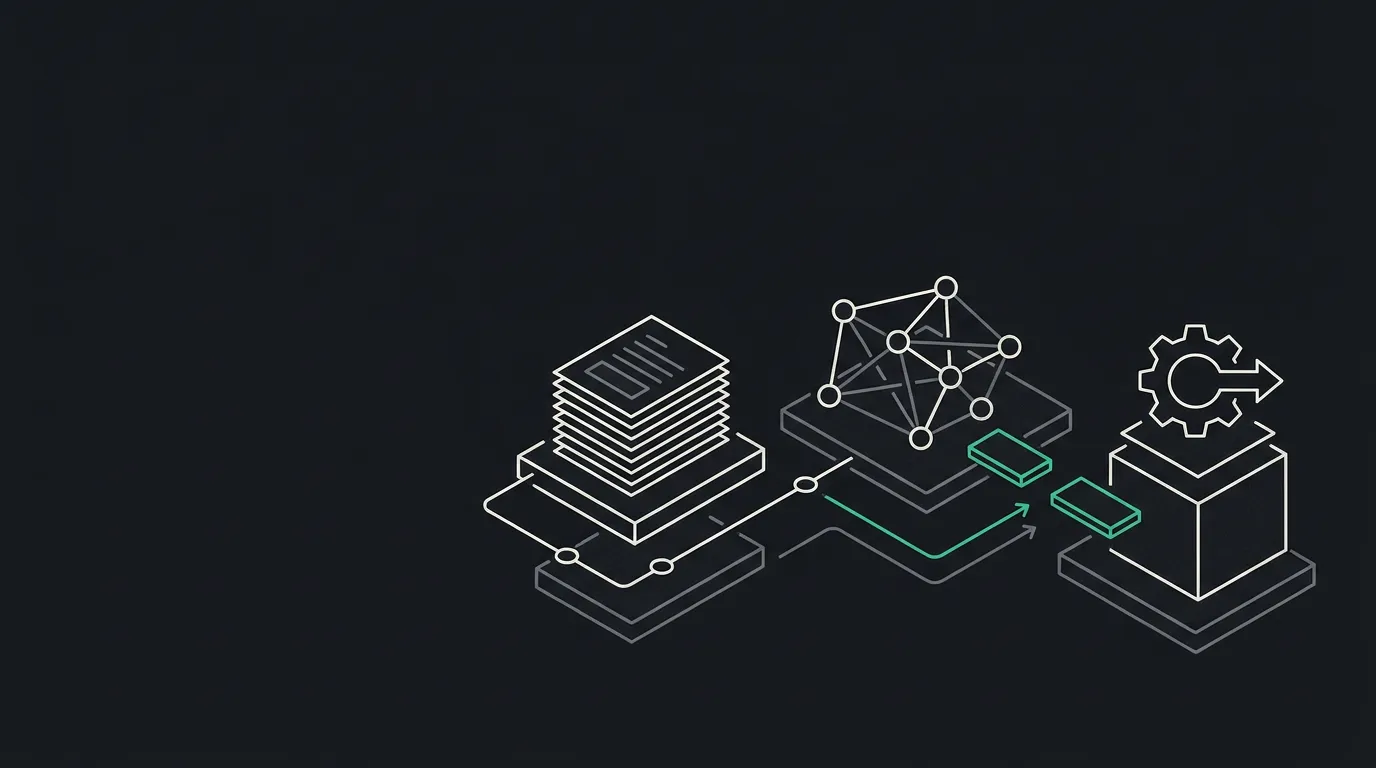
Executive summary
This is a view of where enterprise software is going over the next few years, not a report on where it is today. It is written for leaders deciding where to place their bets.
Most industrial companies have spent a decade recording everything. Every order, every shipment, every tonne of CO₂. Then they added AI that turns those records into forecasts and recommendations. Good forecasts. And the last step still falls to a person: read the recommendation, decide, act.
That last step is the action gap: the distance between a decision made and a decision taken. It is where the next wave of value is going, and the technology to close it is arriving. Agentic AI executes a decision instead of just recommending it. Capability is no longer what is missing. Two things are. The rationale the decision needs, the contract term and the tacit constraint that never made it into any record. And the control that lets a leader trust the system to act: the audit trail, the approval tiers, the rollback.
The paper argues three things. First, the durable advantage is moving away from the AI model, which is commoditising, toward the intelligence that crosses internal records with outside signals, and toward the decision rationale that no record ever stored. Second, the action layer will sit on top of that intelligence, not inside a single system of record. Third, the barrier left once capability is solved is not model quality. It is getting that rationale into the system and governing what it does with it. That is the competitive frontier.
Takeaway: the direction of travel is record to intelligence to action. The strategic questions for a leader are where to invest for defensibility, who will capture the action layer, how much of the decision rationale you have actually captured, and how to earn the trust that autonomous action demands.
1. The data-rich, action-poor enterprise
Start with a scene that already plays out in planning teams running good software. The system reads the demand signal, works out the replenishment, and could place the order itself. It is right, week after week. The planner beside it still will not let it act.
Ask her why and the answer is not fear of the machine. It is a list of things the system does not know. This customer accepts short shipments in December, never in the first quarter. That supplier’s quoted lead time runs a week optimistic when the currency moves. We do not reorder this line until the annual audit closes. None of it is in the ERP. All of it is in her head. And beneath the list, the question nobody has answered: if it acts and it is wrong, who carries it?
That scene is the whole paper in miniature. The data is there. The action still waits on a person, for two reasons. The system does not hold everything she knows. And no one has made it safe for it to act. Hold on to her; we come back to her once both problems are on the table.
Enterprise software has been very good at one thing: recording what happened. ERP captures demand, inventory, production, and transport with high fidelity. Sustainability systems now do the same for emissions across the value chain. This is the system of record. The authoritative, audited source of truth for one slice of the business.
A record decides nothing. It waits to be asked. For years the value in that data sat behind human effort. Someone pulls the report, reads it, reconciles it against three other systems, and picks an action. The data is rich. The action is slow, inconsistent, and expensive in senior attention.
Decision intelligence narrowed the gap. Forecasting, price prediction, and optimisation turned static records into guidance. Here is what demand will do. Here is what to reorder. Here is where your emissions are drifting. Real progress. But it stops one move short. The guidance lands on a human desk, and the human is still the bottleneck between insight and outcome.
Here is the part most companies will not say out loud: they paid for intelligence and still run at the speed of manual action. The forecast is excellent. The order goes in three days later, by hand, sometimes overridden for reasons nobody writes down. The emissions hotspot is flagged. The fix waits for the next quarterly review. That distance between knowing and doing is the action gap, and it is where margin, working capital, and carbon leak.
2. Three layers, one stack
Name the layers plainly, because the market has muddled the words.
System of record. What is true. The authoritative store for a data domain. ERP for financials and inventory, a sustainability platform for emissions. Its job is accuracy and auditability. Every serious company has one, so it is necessary but no longer where you differentiate.1
System of intelligence. What will happen, and what to do. The layer that works the records: forecasting, price prediction, anomaly detection, optimisation. Its value comes from combining sources. Internal ERP history plus outside demand, price, and emissions signals, turned into guidance no single record could produce.2
System of action. What happens next, and it does it. An agentic layer that turns a decision into an executed outcome. It places the order, triggers the procurement, runs the correction. This is not the automation you already own. RPA replays a fixed script and breaks the moment reality moves. A system of action reasons over context and handles the exceptions that make up most of real operations. That is also why it needs a different kind of oversight.3
Quick test. A system of record answers “what is true?” A system of intelligence answers “what should we do?” A system of action answers “what happens next?”, then does it.
3. Why one system can’t hold it
Here is the structural problem. A system of record is one system with one boundary. An ERP is authoritative about its own data and blind to everything else. Fine for recording. It fails the moment you want to reason or act.
The decisions worth making pull from several records at once. A good replenishment call needs demand from the ERP, the customer from the CRM, the supplier lead time from the SRM, and the price from a market feed. No single system holds all four. The decision lives in the overlap.
In practice, combining data across records is where the real advantage shows up. Not the forecast off one system. The decision that only makes sense when several systems are read together. A demand pattern means one thing next to a supplier’s lead time and another next to the price curve. Read them together and you see what no single system can.
It is how good decisions get made anywhere, in life as much as in business. You weigh every option and every opinion, measure them against each other, then decide. A system that sees only one record is deciding with most of the room silent.
So intelligence and action have to be additions on top of the records, not features built inside one of them. Built into a single record, they inherit its blindness. Built as a layer above, they use everything. A single system, however good, is fenced in by its own access and boundaries. This holds even for the incumbents. The modern ERP platforms answer it by building their own layer above the record, not by teaching the record to reason across systems it cannot see. Either way the layer is separate. Who owns it is a separate question.
Data access is becoming contested ground. SAP’s 2026 API policy restricts third-party AI agents from SAP data while letting SAP’s own tools through. Salesforce and ServiceNow, for now, stay open.4 Read one way, gating agents off a production core is sensible operational hygiene. Read another, it is a fight over who gets to build the layer that spans the records. Both readings are true.
The architecture pattern itself is old. Mainframe teams never wired systems straight into the core. They pulled data into a layer they controlled and let everything consume from there. The names changed to Kafka and change data capture. The pattern did not. This layer is not free. It adds data movement, latency, a new security surface, and, on SAP, potential indirect-access licensing. Those are the real costs of centralisation, and they are the price of reasoning and acting across records no single system can see.
That central layer, wherever it ends up living, is the system of intelligence, and one rung up, the system of action.
4. Why now
Three things changed at once.
The capability landed. Agentic AI plans, uses tools, and chains steps toward a goal. Executing a bounded operational decision is now realistic.
The model is ceasing to be the moat. Capable open models are everywhere, so the raw model is commoditising. Value is moving up the stack, toward the intelligence that combines proprietary and outside data, and outward, toward the ability to act on it.2 The biggest incumbents are spending accordingly, buying their way up into that layer rather than resting on the record.
The organisation is almost ready. Companies that invested in decision intelligence already have the launch pad. What holds them back is trust. The sensible refusal to let software act when nobody has answered what happens if it acts wrong, and who owns it. That refusal is rational. The rest of this paper takes on the two hard problems behind it: getting the rationale into the agent, and earning the trust to let it act.
5. The hard part: getting the rationale in
This is the first of the two hard problems. Most people underestimate what closes the action gap. It is not the action. It is the rationale behind it.
A system of record is a table. Structured, clean, and incomplete. The table never held the whole basis for a decision. A person looked at it every day and added what they knew: the contract term that caps this order, the side agreement nobody wrote down, the reason we never ship this line on a Friday, the thing only the planner carries in her head. The table decided nothing. The person did, with context the table never stored.
A system of intelligence reads far more than any person can. But it still hands the answer back to that same person, who supplies the rationale before acting.
Move to action and that context has to live in the agentic layer. All of it. Contractual terms. Undocumented constraints. The tacit knowledge only the people hold. Getting that rationale in, and keeping it current, is the real work.
The frontier labs are proving the same point from the other end. Anthropic reported that teaching a model the reasoning behind a decision, the why, cut misaligned behaviour from 22% to 3%, far more than training on examples of the right action alone.5 Meta has begun recording its own employees’ keystrokes and mouse movements, because the way skilled people work is not captured in the work they produce.6 When the companies building the models conclude that the scarce material is the reasoning and the behaviour, not the output, the lesson for everyone else is hard to miss.
The timing helps. We are leaving a world where data had to be structured to be useful. Formats, sources, and channels are diverging: contracts, emails, tickets, chat, notes, sensor logs. Unstructured, but readable. Modern models read them the way a person does, so the rationale no longer has to be forced into a schema before a system can use it.
That points to one design principle for the action layer: decouple data structure from action. Do not make the rigid table a precondition for acting. Let the layer read context in whatever form it lives, structured or not. That decoupling is what buys scale, speed, and simplicity, and it is why this is possible now and was not five years ago.
One consequence is worth turning into a metric. The number that predicts whether autonomy will hold is not how many agents you have deployed or use cases you have piloted. It is how much of your real decision rationale you have captured in a form a system can read. Count that instead.
6. Where the value goes, and who captures it
Follow the value and it moves up the stack. As the model commoditises, the durable asset becomes the intelligence layer: the models and data pipelines that cross internal records with outside signals and get the answer right often enough to act on. That takes years of domain data, tuning, and validation to build.
Who captures that layer is the open strategic question of the next few years, and it is genuinely contested. Two moves are in play.
Incumbents that own the records, the workflows, and the write-path are climbing up. They are adding intelligence natively and by acquisition. Salesforce paying about $8bn for Informatica is exactly this move.7 They inherit identity, permissions, and transactional write-back for free, which is most of what governed action needs.
Specialists that already own deep, cross-record intelligence are extending down into action. In heterogeneous, multi-vendor estates, where no single incumbent spans demand, supply, and emissions, they have room to be the neutral layer across all of it.
There is no settled answer. In a single-vendor estate the incumbent has the shorter path. In a fragmented one the specialist does. The strategic call for a leader is which bet fits their estate, and how much they want one vendor owning both the record and the action on top of it.
7. Governed autonomy
The second hard problem is trust. Capability is not the limit here. Governance is, and the market is proving it the hard way.
A shakeout is coming. Gartner forecasts that more than 40% of agentic AI projects will be cancelled by the end of 2027, on cost, unclear value, and weak controls. It expects 40% of enterprises to demote or decommission autonomous agents by 2027 once governance gaps surface in production.8 Note the drivers. Two of them, cost and unclear value, are about picking the wrong use cases. The third, weak controls, is governance. The lesson for anyone betting on autonomous action is to solve all three, and not to mistake a governance failure for a technology failure.
Come back to the planner from the start. Her list of things the system did not know was the first hard problem, the rationale, and section 5 was about closing it. Her last question is the second: if it acts and it is wrong, what happens, and who is accountable? No amount of rationale answers that. Only governance does.
The usual response is one of two mistakes. Withhold autonomy completely and capture none of the value. Or grant it everywhere and meet the edge cases in production, expensively. Neither works. Autonomy has to match the stakes of the decision.
A workable model is a ladder with four rungs.9
- Observe. The system watches and reports. Humans act. Zero autonomy, full visibility.
- Advise. The system recommends. A human decides and executes. Most “decision intelligence” sits here today.
- Act with approval. The system proposes a specific action and executes on a human yes. Needs approval workflows and a full audit trail.
- Act autonomously. The system acts inside set guardrails and escalates exceptions. Needs monitoring, rollback, circuit breakers, and a named owner.
A decision climbs the ladder only as it earns trust. Low-stakes, high-frequency, easily reversed decisions like routine replenishment within a band can reach autonomy fast. High-stakes or hard-to-reverse decisions can sit at “act with approval” forever. That is a feature, not a failure.
Two capabilities make the ladder real instead of rhetoric.
Audit trail. Every action, and the data and reasoning behind it, has to be reconstructable after the fact. That is what turns “the AI did something” into “here is exactly what it did, and why.”
Reversibility. Rollback and circuit breakers turn a wrong action from a crisis into an incident. Willingness to grant autonomy tracks confidence that a mistake can be caught and undone.
This is the competitive frontier. Governed autonomy is not a feature you add at the end. It is a discipline you build in from the start: monitoring, data lineage, auditability, and reversible actions. Whoever builds that discipline well earns the right to act autonomously before anyone else, because trust, not capability, is what the market is short of.
8. What this looks like in supply chain and sustainability
The stack gets concrete fast in operations. In each case the same decision climbs the ladder over time.
Replenishment. A forecast predicts demand for an article. Today decision intelligence drops a recommended order quantity into the ERP and a planner confirms it. Next rung: act with approval, where the system proposes the order and places it on one click. Then, for stable low-value items that are easy to correct, autonomous replenishment inside a guardband, with anything odd escalated to a human. The forecast was always the hard part. Acting on it is the value the forecast was for.
Procurement and commodity prices. A raw-material price forecast flags a good window. Instead of showing a chart for someone to notice, the action layer triggers a pre-approved procurement action, or at a lower rung assembles the order and holds it for sign-off. The decision logic is the intelligence. The execution is the action.
Emissions and compliance. A platform that computes emissions across scopes does more than report for CSRD. When it finds a hotspot, a supplier, a lane, a material, the action layer proposes and, where authorised, runs the fix: reroute, re-source, or flag for procurement. Transparency becomes remediation.
Same pattern every time. The record tells you what happened. The intelligence tells you what to do. The action layer does it, at a rung of autonomy you set.
9. A maturity model you can place yourself on
Most organisations can find themselves on a four-stage progression. Naming the stage makes the next move obvious.
- Recording. Reliable systems of record. Decisions are manual and report-driven. Next: add intelligence on top of data you already trust.
- Intelligent. Forecasting and decision intelligence in place. Guidance is good, execution is manual. Next: move your best-understood decisions to “act with approval”.
- Assisted action. The system proposes and, on approval, executes. Audit trails and rollback are in place. Next: promote low-stakes, reversible decisions to guarded autonomy.
- Governed autonomy. Decisions run autonomously inside guardrails. Exceptions escalate. Everything is auditable and reversible. Next: widen the set of decisions that qualify, carefully.
The honest read, and the 2025 data backs it: most companies sit at stage two, rich in intelligence but still manual in autonomous action. Agents drove only about 17% of the value companies got from AI in 2025, so roughly four fifths still came from analytics and prediction, not action.10 That four fifths is the action gap, in one number. Only about 15% of IT leaders were even considering fully autonomous agents, against 75% adopting agents that keep a human in the loop.11 Production use of agents sat near 11%.12
Two honest caveats. First, these figures probably run high. “Agent” is a loose label right now, what Gartner calls agent washing: assistants, chatbots, and old RPA rebadged as agents, and the 15% even counts leaders only considering autonomy, not running it.13 Strip that out and genuine autonomous action sits lower than the headline, which only widens the gap this paper is about. Second, scope the word manual. Plenty of older automation already runs, RPA, rules engines, dynamic pricing. What is still manual is the new, reasoning-driven action. The analysts also agree on the order: autonomy comes after scaled intelligence and real governance, not before. Stage three is a governance project as much as a technology one.
The bottom line
For a decade the job was to record everything, then make the record intelligent. That mostly worked. It created an asset most companies are not using: trustworthy guidance that still waits for a human to act.
The next layer closes the action gap. Built on the intelligence you already have, governed by a ladder of autonomy you control, a system of action is where the return on all that data shows up. Faster decisions. Less working capital and carbon lost in the gap. Senior attention freed for the calls that actually need it.
None of this happens on day one, and it should not. It is a gradual shift. Start where the stakes are low and the questions are old. Small tasks. The analysis nobody had time for. The question that never gets a straight answer: why did we end up in this situation? Let the system earn trust on those, then climb the ladder one rung at a time.
Nobody flips a whole operation to autonomous action overnight, and nobody should. But the journey is long and hard, so it has to start now. The companies that win this layer will not be the ones that act first. They will be the ones that own the intelligence, can act under control, and started climbing early.
The shift from recording to acting will take years, not quarters. The leaders who spend that time building the intelligence and the governance now will be the ones able to act when the technology is ready. The rest will be waiting for permission from their own systems.
References
Full source detail, credibility tags, and the verification record are in
topics/system-of-record-vs-action/sources.md.
Footnotes
-
Moore / AIIM, Systems of Engagement and the Future of Enterprise IT (2010-11). Systems of record are necessary but no longer differentiating. [S1][S14] ↩
-
Chen (Greylock), The New New Moats (2023). Open models commoditise the model layer; value accrues to intelligence that crosses multiple datasets and records. [S15] ↩ ↩2
-
Agentic AI vs. RPA. Reasoning-driven, exception-handling execution versus deterministic scripts. [S13] ↩
-
Wähner, Data Ownership in the Age of Agentic AI: Why SAP’s API Policy Forces a Data Integration Reckoning (2026). SAP restricts third-party agents while allowing its own; the fix is an integration layer you control, following decades of mainframe CDC/MQ practice (now Kafka/iPaaS/CDC). [S25] ↩
-
Anthropic, Teaching Claude Why (2026). Training on the reasoning behind a decision cut misaligned behaviour from 22% to 3%, versus 7% from action demonstrations alone; the principle generalised where imitation did not. [S34] ↩
-
Meta, reported April 2026 (TechCrunch, Fortune). Recording employee keystrokes and mouse movements to train agents on computer-use behaviour absent from the outputs people produce. [S35] ↩
-
Activant Capital on Salesforce’s ~$8bn Informatica acquisition. Owning the system of record alone is not enough. [S16] ↩
-
Gartner. More than 40% of agentic AI projects cancelled by end-2027; 40% of enterprises to demote or decommission autonomous agents by 2027. Forward-looking predictions. [S18][S19] ↩
-
Gartner. Proportional, tiered agent governance (Observe, Advise, Act with Approval, Act Autonomously). Autonomous action needs monitoring, rollback, circuit breakers, ownership. [S19] ↩
-
BCG, The Widening AI Value Gap (Sept 2025, n=1,250 firms). Agents ≈ 17% of AI value in 2025, rising to ~29% by 2028; only 5% of firms capture value at scale, and agent use concentrates among them. Frames agentic AI as the step after scaled intelligence and governance, not the starting point. [S29] ↩
-
Gartner survey (Sept 2025, n=360 IT application leaders). 75% piloting or deploying some form of AI agent; only 15% considering, piloting, or deploying fully autonomous agents. Human oversight remains the norm. [S28] ↩
-
Deloitte, Tech Trends 2026 (2025 survey). 30% exploring, 38% piloting, 14% ready to deploy, 11% actively using agents in production. [S30] ↩
-
Gartner, via CIO Dive. “Agent washing”: assistants, chatbots, and RPA rebranded as agents; only ~130 of thousands of “agentic” vendors judged real (mid-2025). Reported adoption is therefore inflated by relabeling and by counting mere intent. [S18][S20] ↩
Pick One
One company shipped a decision model on 15 September. Seven others had shipped their own by 1 October. What decision models are, and which parts of the launch coverage do not survive checking.

Twenty Rules
Why adding instructions makes your coding agent worse, and what to build instead

The Parking Brake
Kent Beck's 3X model, and why cleaning up too early is a phase mistake most engineering orgs make.