Safe to Be Wrong
Psychological safety is the success factor for every transformation
A colleague said something recently that stuck: what stands out about my teams is that people feel safe being wrong, something he had not felt on a team before. That is worth more than it sounds. It is the thing most teams quietly lack, and few leaders build on purpose.
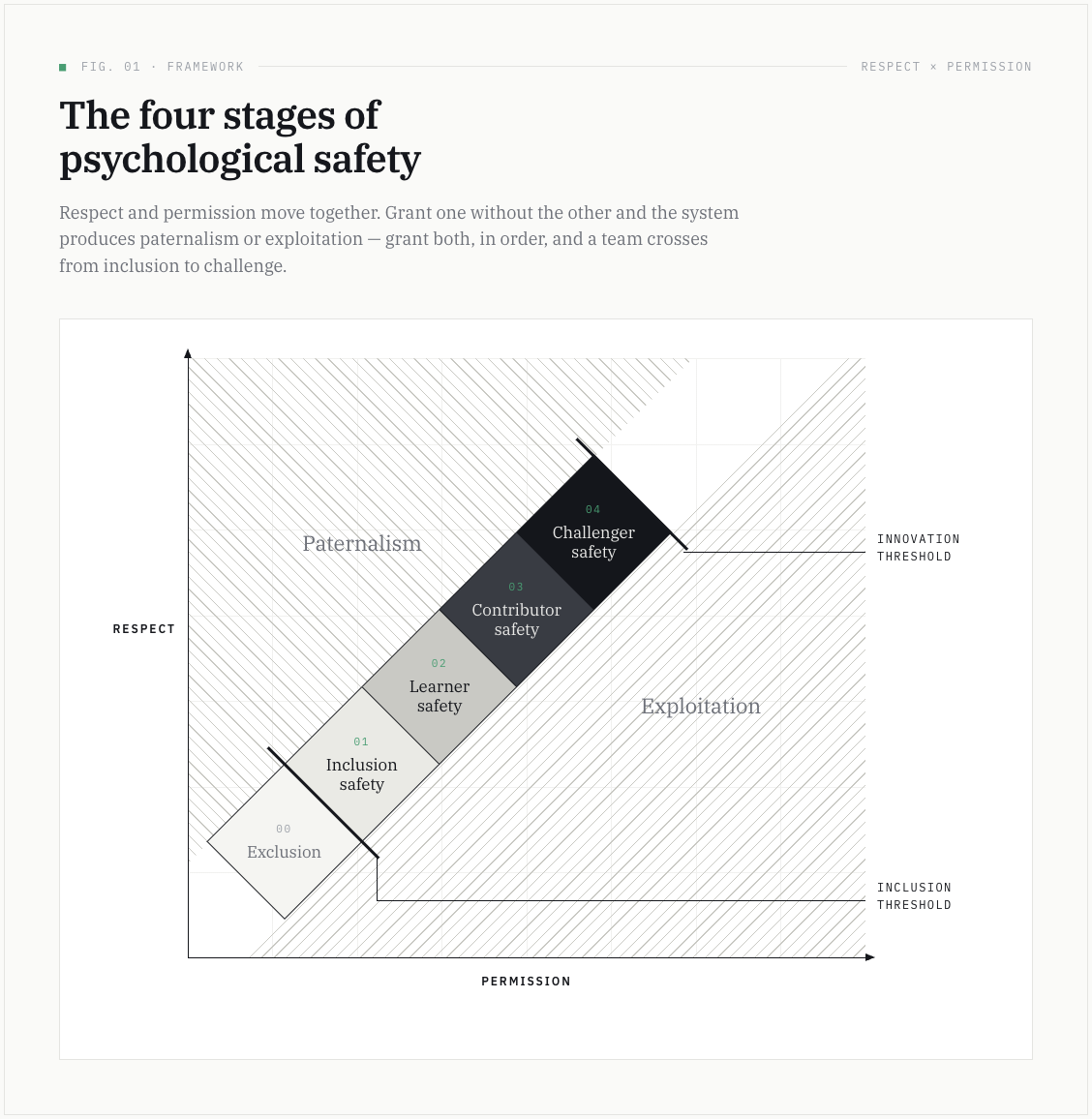
It goes back to a course on psychological safety I took with Karen Kemerling, built on Tim Clark’s 4 Stages model. It reshaped how I lead, and left me with a conviction I have held since: psychological safety is not a soft extra or a culture perk, it is the base a leader stands on. Before strategy, before process, before any tool, people have to feel safe enough to say what they see, admit what they do not know, and be wrong in the open without paying for it. Where that base is solid, the things every leader actually wants, honest feedback, fast learning, real ownership, become possible. Where it is missing, none of them hold, however good the plan looks on paper.
That holds for everyday leadership. In a transformation it stops being a healthy base and becomes the success factor. Any transformation.
Every transformation I have run lived or died on the same thing, and it was rarely the strategy deck or the tooling. It was whether people felt safe enough to be bad at something new in public. A transformation, by definition, takes people who are good at the current way of working and asks them to be beginners again: to drop what they are expert in and fumble in front of their peers and their boss. That is uncomfortable. Where it is also unsafe, people do the rational thing. They protect their image instead of changing. They nod in the workshop and go back to the old way at their desk. The programme stalls while every status report stays green.
This is not a hunch, it is one of the most robust findings in organizational science. Amy Edmondson’s 1999 field study of 51 teams showed that psychological safety, the shared belief that a team is safe for interpersonal risk, drives learning behaviour: asking for help, admitting error, raising the hard question. A 2017 meta-analysis pooled 136 samples and more than 22,000 people and found the pattern holds at scale, with safety tied to engagement, information sharing, and performance. Google reached it from the other side: after studying 180 of its own teams in Project Aristotle, it named psychological safety the single biggest thing separating its high performers from the rest. Change is a learning problem, and safety is what lets a group learn out loud.
The research is honest about the edges. Pushed to an extreme on routine, standardised work, very high safety can even nudge raw task output down a little. But a transformation is not routine work. It is learning something new in public, and there the effect runs one way.
Clark’s definition is the one I keep coming back to.
Psychological safety is an environment of rewarded vulnerability.
Not comfort, not niceness, not the absence of disagreement. It is whether sticking your neck out gets rewarded or punished. His four stages climb from inclusion safety, through learner safety and contributor safety, up to challenger safety. Two of them are exactly what a transformation puts under strain. Learner safety is whether it is safe to be a visible beginner: to fumble, ask the dumb question, get it wrong on the way to getting it right. Challenger safety is whether it is safe to say “this is wrong,” including when the thing that is wrong is the plan, the tool, or the person one level up.
AI is where all of this becomes impossible to ignore. An AI transformation is the biggest change most companies have taken on in years, and it stresses both of those stages harder than anything before it. It makes everyone a beginner again, senior people included, which is a direct hit on learner safety. And it asks people to challenge a machine that produces fluent, confident answers that are sometimes just wrong, which is a direct hit on challenger safety. A change that attacks the two exact stages a programme depends on will expose whatever safety a team has built, or has not.
The failure modes of a stalled AI rollout all trace back to the same root.
People fake fluency. Admitting you cannot get the tool to work feels like admitting you are behind. So they perform competence and quietly avoid the thing.
People stop reporting the misses. The model is confidently wrong sometimes. If flagging that gets you labelled a skeptic or a blocker, the errors stop surfacing, and trust in the whole system erodes in the dark.
The knowledge never pools. The shared library of what actually works, the prompts, the patterns, the guardrails, only fills up if people also post what did not work. That takes safety.
The current data backs this hard. In 2025 MIT’s NANDA initiative looked at 300 AI deployments, 150 leaders, and 350 employees and found that 95% of enterprise generative-AI pilots deliver no measurable return. Their verdict on why is blunt: the barrier to scaling is not infrastructure, regulation, or talent, it is learning. The winners are not the ones with the best model, they are the ones who build feedback loops and adapt, which is an organisational-learning problem before it is a technical one. The learning that matters most is not a course you run. It is the will to change how the work is done at the root, and that surfaces only when people challenge each other openly and honestly, all the way down to first principles, which takes absolute trust in each other.
When a cautious incumbent gets it right, this is what it looks like. Moody’s, a century-old risk-assessment firm in one of the most conservative industries there is, went all in on generative AI under CEO Rob Fauber by running it as continuous adaptation rather than a fixed target: everyone in, ideas built on instead of shot down, judged on real impact. That is learner and challenger safety, described in operating terms.
The clearest signal of a real transformation is not the polished demo in the steering meeting. It is people openly sharing what failed: the prompt that bombed, the output that was garbage, the approach that did not land, and saying plainly that the current way is not good enough. That behaviour does not appear on its own, it gets built, and the habits that build it are quiet ones. Going first with your own misses. Asking for the bad news by name instead of waiting for it to surface. Weighing in last, so the most senior view does not close the room before it opens. Treating the person who says “this is wrong” as an asset, even when the idea turns out wrong too. That is rewarded vulnerability in practice, and it is how a team climbs the curve fast.
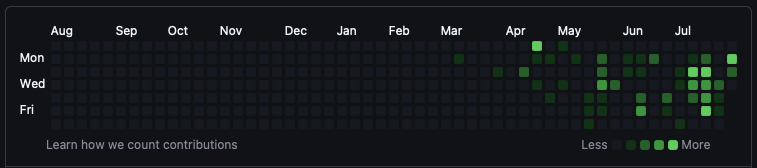
The same signal shows up wherever people step outside their old lane. A product owner’s GitHub contribution graph lighting up after years of darkness. Developers sharpening ticket quality instead of just working the tickets, digging into the context, getting closer to the customer. None of that sits in a job description. It happens when the boundaries feel safe to cross.
When all you see is success stories, the learning has gone underground, and the numbers disappoint you later.
This is also why “move fast, everyone must adopt now” backfires. Pressure and safety pull in opposite directions. If everything is urgent and every miss reads as a performance problem, people optimise for looking competent, which means hiding exactly the failures the organisation needs to see. Even the executives admit it: in one 2025 survey more than a fifth said they had held back from leading an AI project for fear of being blamed if it missed. The alternative is not complicated. Make room for experimentation and small failures. Bring people into the change instead of imposing it. Lead with clarity over certainty, clear about what is known and honest about what is not. Trust comes from consistency, not from pretending to have all the answers. Three CHROs on a recent HBR panel made the same point from the people side.
None of this is soft. It is the most practical lever a leader has, and it cannot be bought, only built. Psychological safety is not the culture workstream running parallel to the real programme. It is the programme, and I run it as one. The tools and the plans are for sale to everyone. A team where it is safe to be a beginner and safe to say “this is wrong” is the part a competitor cannot copy, and it is what lets a change actually take.

The Photocopier
What happens to Conway's Law when AI writes the code
Pick One
One company shipped a decision model on 15 September. Seven others had shipped their own by 1 October. What decision models are, and which parts of the launch coverage do not survive checking.

The Parking Brake
Kent Beck's 3X model, and why cleaning up too early is a phase mistake most engineering orgs make.